

Why “2 km / 3 km / 5 km” Is Misleading
When customers compare industrial sirens, one of the biggest misunderstandings is the “range” mentioned in brochures—2 km, 3 km, 5 km, and so on. These numbers often create unrealistic expectations because they are interpreted as the distance a siren will be heard in any condition.
But in reality, siren range depends on multiple environmental and installation factors. In this post, we break down what the range truly means, why conditions drastically change the actual performance, and how to ensure complete coverage in real industrial settings.
What ‘Audible Diametrical Range’ Really Means
The “range” you see in brochures is not measured inside a factory, near machinery, or around buildings. Instead, these figures represent ideal, controlled test scenarios. The audible diametrical range is measured:
✔ In still air
✔ In open, obstruction-free space
✔ As a full 360° diametrical spread
These numbers reflect a perfect environment, not real-world industrial conditions. Actual performance inside an industry varies based on obstacles, wind, installation height, and noise levels—factors that drastically affect how far sound can travel.
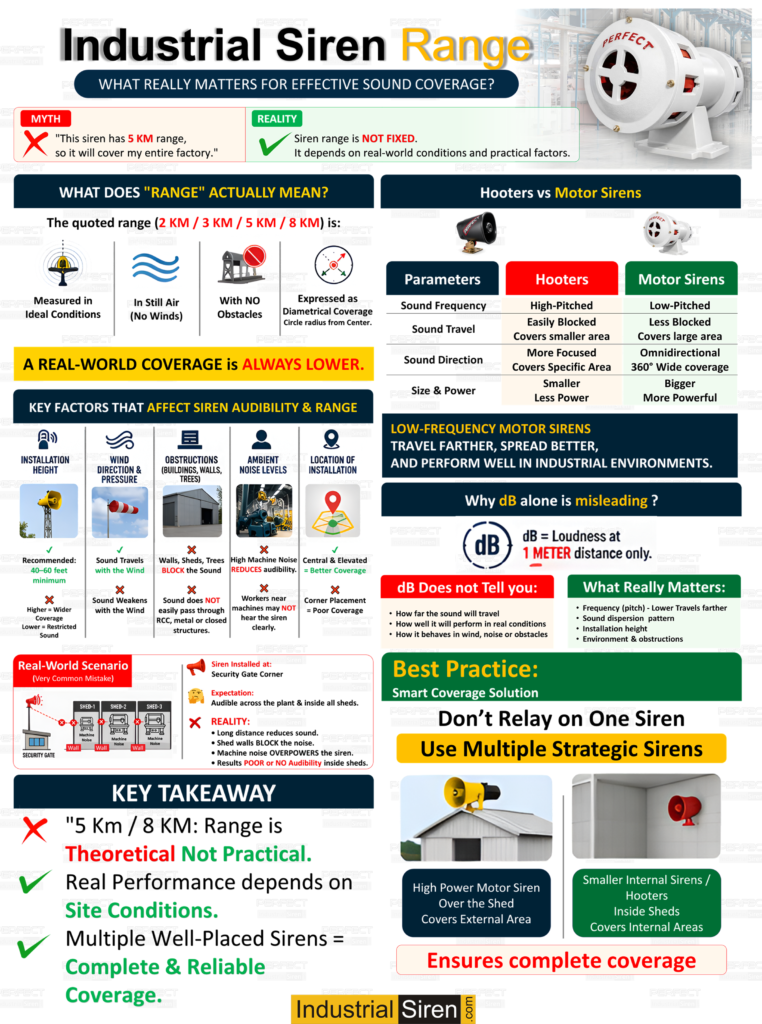
Key Parameters That Affect Siren Range
To understand why sirens behave differently in practical environments, here are the real factors that influence how far the sound can travel:
1. Height of Installation
- The siren must be installed at 40–60 ft minimum for effective coverage.
- Higher installation allows the sound to travel much farther.
- A low installation—like mounting at gate level or on a small pole—reduces the audible range drastically, especially in congested areas.
2. Wind Conditions
- Wind can push the sound away from the desired area.
- When the wind direction is opposite, the audible distance can reduce significantly.
- This is why open-area sirens behave differently on windy days.
3. Ambient Noise Levels
Industrial environments are full of sound-absorbing noise sources such as:
- Machines
- Compressors
- Traffic
- Blowers
- Other running equipment
These noises reduce how clearly a siren is heard.
A 120 dB siren, for example, may effectively behave like 90–95 dB inside a noisy shed, especially during production hours.
4. Physical Obstructions
Sound weakens or gets blocked by:
- Factory walls
- Closed shutters or doors
- Metal structures
- Conveyors
- Multiple rooms or sections
A gate-mounted siren, even if very powerful, cannot penetrate solid walls and heavy machinery noise. This is one of the biggest practical misunderstandings—many factories place a siren at one corner and expect it to be audible everywhere inside.
Correct Installation Strategy
Wrong Practice
Installing one big siren at the security gate and expecting it to be heard clearly inside enclosed sheds.
This never works in real life because the sound must battle walls, machinery, and multiple noise sources.
Correct Practice
To ensure reliable alerting:
✔ Install a large motor siren outdoors—preferably on the roof or a high mast—for long-distance external coverage.
✔ Install small internal hooters or sirens inside the factory shed for clear, local alerts.
This combination ensures complete indoor + outdoor coverage, even in noisy, obstructed environments.
Why dB Rating Alone Is NOT Enough
A siren’s decibel rating is commonly used for comparison, but it tells you only one thing:
👉 How loud the siren is at a distance of 1 meter.
It does not show:
- How far the sound will travel
- How much the sound will be blocked by walls
- How wind affects its travel
- How well it penetrates sheds
- How effectively it overcomes machine noise
Therefore, choosing a siren model based only on dB levels—without considering frequency, obstruction, environment, and installation height—can lead to incorrect decisions.
Hooter vs Motor Siren
Understanding the difference between the two helps buyers select the right siren for the right area.
Hooters
• High-pitch (short travel)
• Directional sound
• Easily blocked
• Small & low power
• Suitable mainly for indoor use
Motor Sirens
• Low-pitch (long travel)
• Omnidirectional sound
• Less blocked by obstacles
• Powerful, long-range
• Best suited for outdoor alerting
Key Takeaway
Siren performance is affected by height, wind direction, ambient noise, and physical obstructions.
This is why dB alone can never determine the actual audible range inside an industry.
For the best safety and coverage:
Outdoor motor siren + indoor hooters = Perfect 360° alert system.
This strategic combination ensures every corner—inside and outside the factory—is covered effectively.
